
Brake rotors are perhaps the single biggest influence on brake force, thermal management, and component longevity within a braking system. While callipers and pads also play essential roles, it’s the rotor that directly absorbs, stores and dissipates the kinetic energy generated under braking. This post breaks down the engineering benefits of upsizing brake rotors and explores when – and why – it matters most.
Increased Thermal Capacity
The primary advantage of a larger brake rotor is increased thermal mass. Thermal mass refers to a component’s ability to absorb, store and dissipate heat. A larger rotor typically contains more material, giving it the ability to absorb more energy before reaching temperatures that cause fade.
Kinetic energy converted to heat during braking:
Where:
Q = Kinetic Energy
M = Mass
V = Velocity
This equation describes the amount of energy a moving car has due to its motion. When you apply the brakes, that kinetic energy is converted via friction between the brake pads and rotors. A heavier, larger rotor can store more of this without exceeding its thermal limit, reducing the onset of brake fade.
Lower Rotor Temperatures = Lower Pad Temperatures.
This energy becomes heat during braking. A heavier, larger rotor can absorb more of it without exceeding its thermal limits, delaying or even eliminating brake fade. This is especially critical in motorsports or track applications, where the braking scenarios are high load and frequent.
Since rotors handle a majority of heat dissipation in braking systems, cooler rotors will often result in cooler pads. By reducing extreme thermal cycling, pad life is extended, friction stability improves, and braking consistency increases across multiple laps or stages.
Improved Heat Dissipation
All brake rotors (to my knowledge) are air-cooled. Increasing surface area is the most effective way to enhance cooling. A larger rotor has more exposed surface area for convection and radiation, meaning more heat can be shed into the atmosphere per unit time.
This is a function of surface area to volume ratio, where a larger surface area will always result in faster heat dissipation.
Larger Rotors Work Less
Brake force is a product of 2 elements:
- Effective Piston Radius.
- Pad Area.

When you increase rotor diameter, you’re effectively giving the brake system more mechanical leverage, just like using a longer wrench. That means for the same clamping force from the calliper, the system produces more deceleration torque at the wheel.
Component Longevity
Retaining your calliper and upsizing your rotor allows the same braking force to be achieved using less pad pressure, less piston travel and lower pad temperatures. This means:
- Pads wear slower.
- Pistons experience less stress.
- Rotors experience fewer extreme thermal cycles.
Potential Trade-Offs To Consider
A technical upgrade is never without compromise. Here are some considerations to account for, along with an assessment of how these problems can be mitigated.
Unsprung and Rotational Mass
Larger rotors are either heavier or position their mass further from the axis of rotation, both of which impact performance.
- Increased unsprung mass reduces suspension responsiveness and steering characteristics.
- Rotational inertia rises, reducing acceleration and increasing rotating momentum.
These issues are often mitigated with two-piece rotors, where an aluminium hat is bolted to a steel or cast iron ring. This reduces both weight and rotational inertia without sacrificing rotor diameter or thermal capacity.
Brake Bias and System Balance
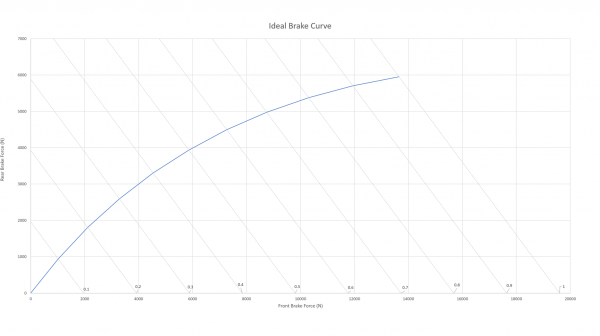
Altering the rotor diameter changes the braking torque on the front and rear axles. Each car comes with a unique ‘ideal brake curve’ which dictates the front-to-rear brake torque balance that gives the car the amount of braking possible from both axles without locking up. For the absolute best braking distances, you will want to target your specific brake balance such that all four tyres are decelerating as much as possible.
This issue is resolved by;
- Understanding the ideal brake curve for your specific vehicle.
- Upgrading the rotors (or piston areas) to match.
I’m reluctant to suggest a proportioning valve as a solution – I prefer to view the valve as a tuning tool, not a solution to counter incorrect brake bias on a large scale.
Should You Upgrade?
Are you boiling brake fluid? Are you chewing through pads or rotors? Are you experiencing brake fade? Then almost definitely, yes.
Larger rotors are my go-to solution when thermal load is the limiting factor. They provide more thermal capacity, greater mechanical advantage, and improved heat dissipation – all with tangible results on track.
There are some trade-offs, predominantly in increased unsprung and rotating weight. However, there are both solutions to mitigate the drawbacks as well as the argument that these drawbacks are more theoretical rather than measurably present. Regardless, more often than not, the performance benefits far outweigh the drawbacks discussed.
We (HFM.Parts) have a range of Rotors & Upgrade Kits to suit just about every application.
Whether your looking for direct replacement rotors, bigger rotors that retain existing calipers or a complete brake upgrade – with our fast growing range, we likely have a kit for you.
