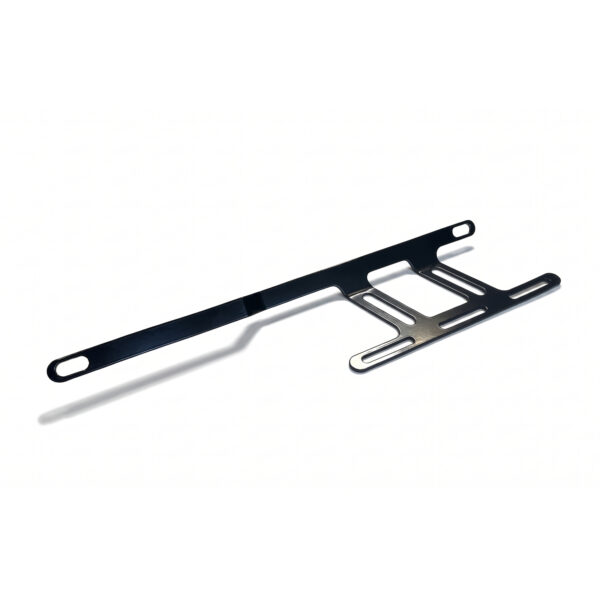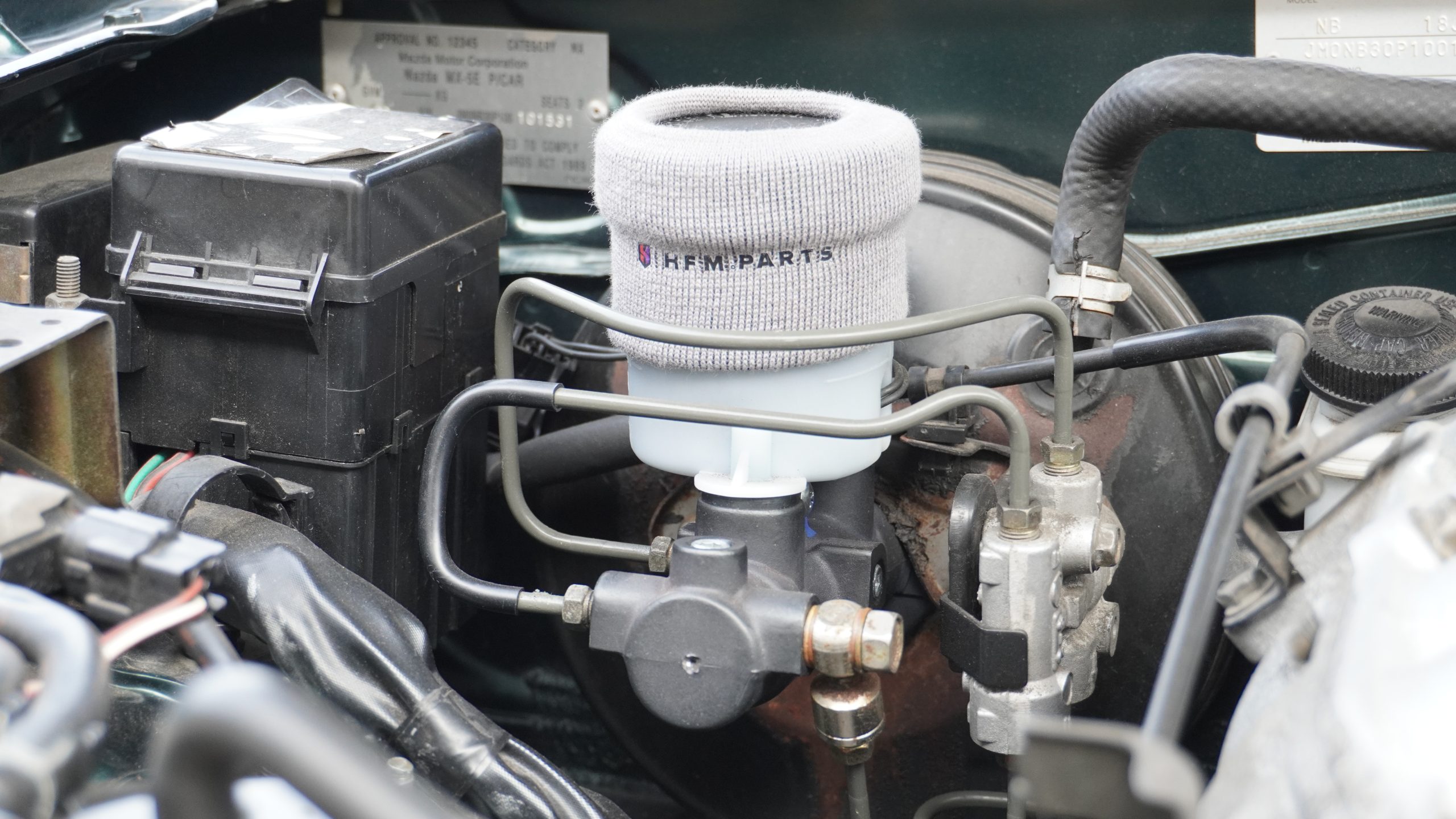
Soft brake pedals aren’t cool.
If you’ve just installed a big brake kit and noticed your pedal feels spongy, you’re not alone. This occurs because bigger brake callipers often feature a larger piston area (via. larger diameter or higher number of pistons). This increase necessitates a higher total fluid volume to move the pistons and apply the pads to the rotor. Without upgrading the master cylinder, big brake kits often result in a longer pedal stroke or a softer pedal response. This isn’t a loss in braking power, but the modulation and immediacy of the brake pedal take a hit, even with good brake pads.
This undermines confidence when it comes to consistent braking points on track and makes trail braking more difficult to execute.
There are multiple ways to gain a firmer brake pedal; this post will cover two primary options: Big Bore Master Cylinder and Booster Deletes. These two options both result in a firmer pedal feel, but they achieve this via. different mechanisms – leading to differences in the outcome. As a result, there’s no singular “best” approach for all cars, but I can comfortably generalise and suggest which option may be better depending on your use case. Let’s first look at how a big-bore master cylinder kit works and then compare the two options.
How a Big Bore Brake Master Cylinder Works:
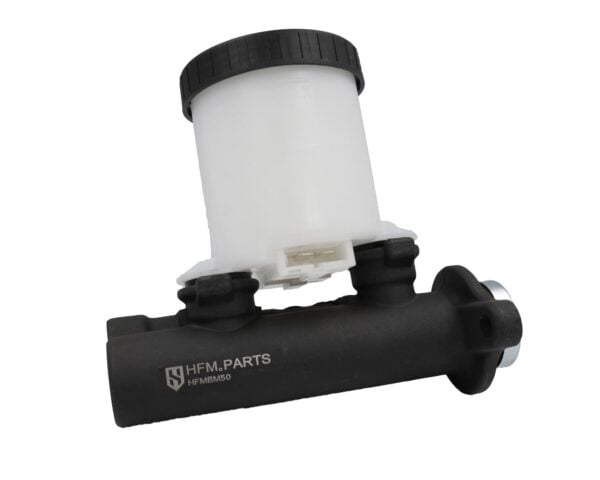
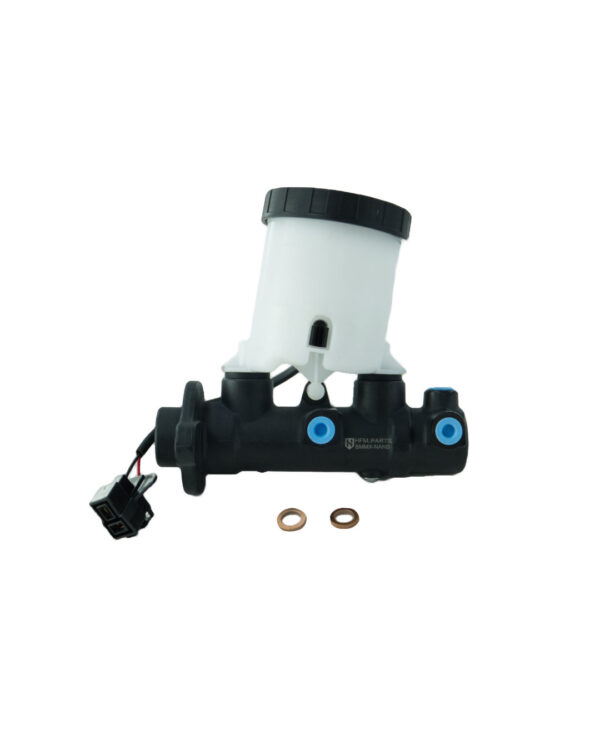
When you press the brake pedal, the master cylinder pushes fluid into the lines, actuating the callipers. A larger bore master cylinder displaces more fluid with each stroke, which is key to shortening pedal travel and restoring firmness after a calliper upgrade.
We can understand this relationship using the basic pressure formula:
Where:
- P is hydraulic pressure,
- F is the force applied by your foot,
- A is the area of the piston (bore size).
Let’s contextualise this with some numbers. For this example, I’m going to use the MX-5 OEM Master Cylinder size, 7/8″ (22.225mm) and the HFM.Parts Big Bore Master Cylinder for Mx-5’s, 1″ (25.4mm). We’re going to compare data using 475psi (32,279,011 Pa), which is about the peak brake pressure you would see on a track-focused Mx-5.


OEM Brake Master Cylinder (7/8″ Diameter)
HFM.Parts: Big Bore Brake Master Cylinder (1″ Diameter)
Looking at these numbers, we can see that the amount of pedal force required to generate the same amount of brake line force is significantly higher for the HFM.Parts: Master cylinder.
A larger bore size increases the fluid volume per unit of pedal movement. However, because the area increases, the pressure produced for a given foot force decreases—this is the trade-off. You get less mechanical advantage, but the pedal becomes firmer and shorter in travel.
For most modified street or dual-purpose cars, increasing the master cylinder bore size is the ideal solution. It’s a bolt-on fix that restores proper pedal feel and modulation without sacrificing low-speed drivability. Pairing this with a well-matched booster retains the convenience of assistance during daily driving while delivering sharper response and better control under performance conditions.
That said, go too big and you may overshoot, ending up with a pedal that is too stiff or lacks progressive feel. That’s why sizing should always be considered in the context of your callipers, brake pad friction, and desired pedal characteristics.
Option 1: Big Bore Master Cylinder
What sold me on this component wasn’t necessarily the feel, but the confidence it promised to inspire. Consistency and feedback are the two big things I look for when driving on track. A soft or vague pedal makes it challenging to gauge how much braking force you’re applying or how close you are to the limit of grip, which directly impacts how late I can comfortably wait before braking for a corner. More specifically, the braking zones for T1 and T10 at Winton raceway were my two slowest deltas relative to others in similar cars. Both issues I linked back to uncertainty around the brake pedal.
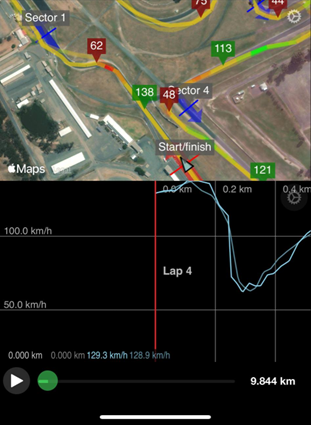
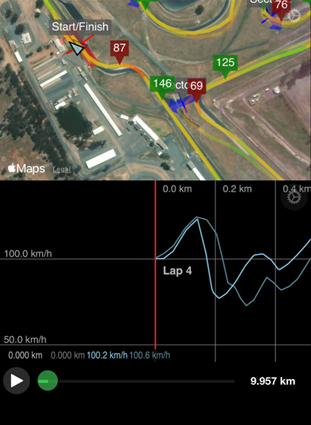
Acknowledging that the increase in performance is predominantly psychological means that I admit that this component doesn’t necessarily make your car stop any faster. This is a modification that helps to build driver confidence, and I hope that these images demonstrate that to some extent. I was able to brake harder and later because I had:
- A more consistent pedal benefits heel-toe downshifting, which in itself helps to slow the car more effectively
- Firmer feedback helps with threshold braking techniques, such as trail braking
- Better pedal feel, which helped me come into the zone with more confidence
Option 2: Brake Booster Delete
There’s a more ‘hardcore’ option to a firmer brake pedal – a brake booster delete. The brake booster, which is typically vacuum-assisted, helps to reduce pedal effort, making braking easier in daily driving scenarios. Removing it creates a fully mechanical system where the pedal force you apply is directly transmitted to the master cylinder with no assistance in between.
The benefits of this approach are centred around feedback and consistency. With no assist, the pedal becomes very linear, and your braking force is more proportional to the pressure you apply, which is not always the case with a booster. This makes for a very responsive system, ideal for motorsport environments where repeatability and brake pedal feel are critical.
There are a lot more drawbacks with this system as well, however. The pedal effort without assistance is more demanding than the typical big-bore master cylinder. This is fine for when you’re braking hard at 200 kph, but tiring when driving in traffic conditions.
It’s also worth noting that most factory pedal boxes are designed with a lower mechanical advantage, with the underlying assumption that the booster will help with the force multiplication. Without the booster, you’d need to assess if your existing brake boxes will require any fabrication or re-engineering.
Choosing the Right Approach for You
So, how do you decide between these two very different paths?
- If you’ve upgraded to larger callipers and want to maintain or restore factory-like pedal travel with better response, a bigger master cylinder is the logical and safest step.
- If you’re building a race car from the ground up, aiming for maximum brake feel, consistency, and simplicity—and are ready to redesign your pedal assembly—a booster delete might be the better solution.
For most performance builds, a balance can be struck. Slightly increasing the master cylinder bore, retaining a vacuum booster, and making sure the system is well-bled and matched will yield a firm, responsive pedal that remains usable on the street.
Concluding Thoughts
There’s no one answer when it comes to brake pedal feel, which is a good thing. Available are two great options to consider, both of which have their advantages for various applications. This ends up being a discussion on what trade-offs you’re willing to accept.
I’ve been running my big bore master cylinder on my daily and track Mx-5 for 3 months now. As I spend close to two hours daily driving through peak-hour city traffic, I know that my choice to go with the big master cylinder route was right for me.