Theres a common paradigm in performance engineering that ligher components improve the agility of a car. This is often true – but it’s also incomplete. There are several overlooked factors that this premise is contingent on – especially when we discuss brake rotors. In this case, how that weight is distributed can be just as important as how much mass there is.
Unsprung Mass
Unsprung mass can be defined as anything that moves when the suspension moves – the wheels, tyres, brake rotors, callipers and other components that are directly connected to the hub.
There’s also semi-sprung mass – components such as the control arms or the tie-rods – which connect the unsprung and sprung assemblies. Everything else, (the chassis, body, drivetrain, etc.) is sprung mass, supported and damped by the suspension.
Unsprung mass is best understood as a percentage of the total vehicle mass. Lighter cars, like the Mx-5, are more sensitive to this because the unsprung components represent a larger portion of the total mass. Heavier cars, are less sensitive to small changes in the unsprung assembly as their unsprung assemblies typically make up less of the total vehicle mass (proportionally speaking).To best describe how and why unsprung mass matters, let’s analyse the following scenario:
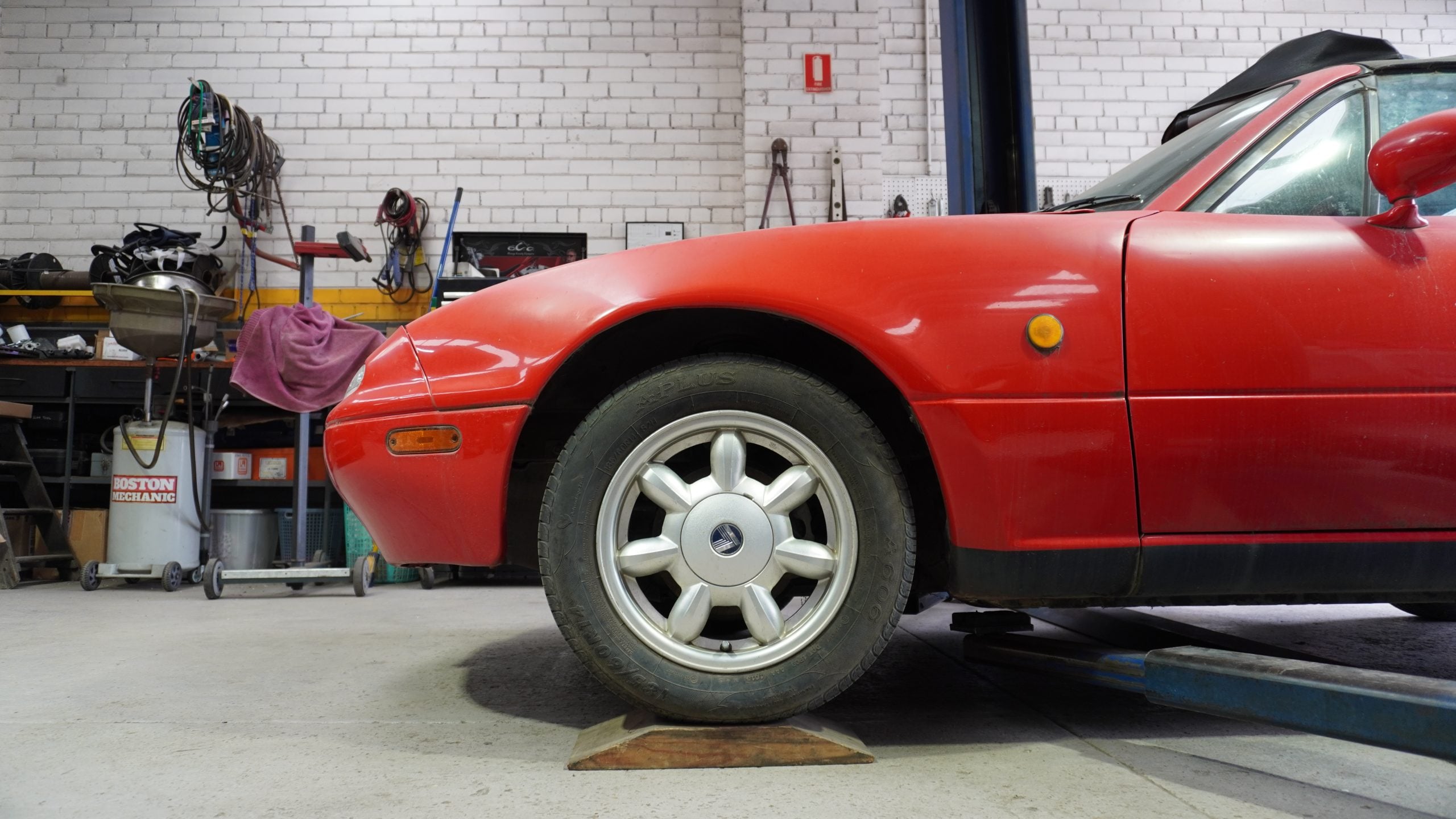
Scenario 1: Just the Unsprung Assembly Moves
Typically the ideal case; the tyre reacts quickly to follow the surface contour, and the suspension isolates the cabin from most of that motion. The driver barely feels the bump and the tyre maintains contact – therefore grip with the road surface.
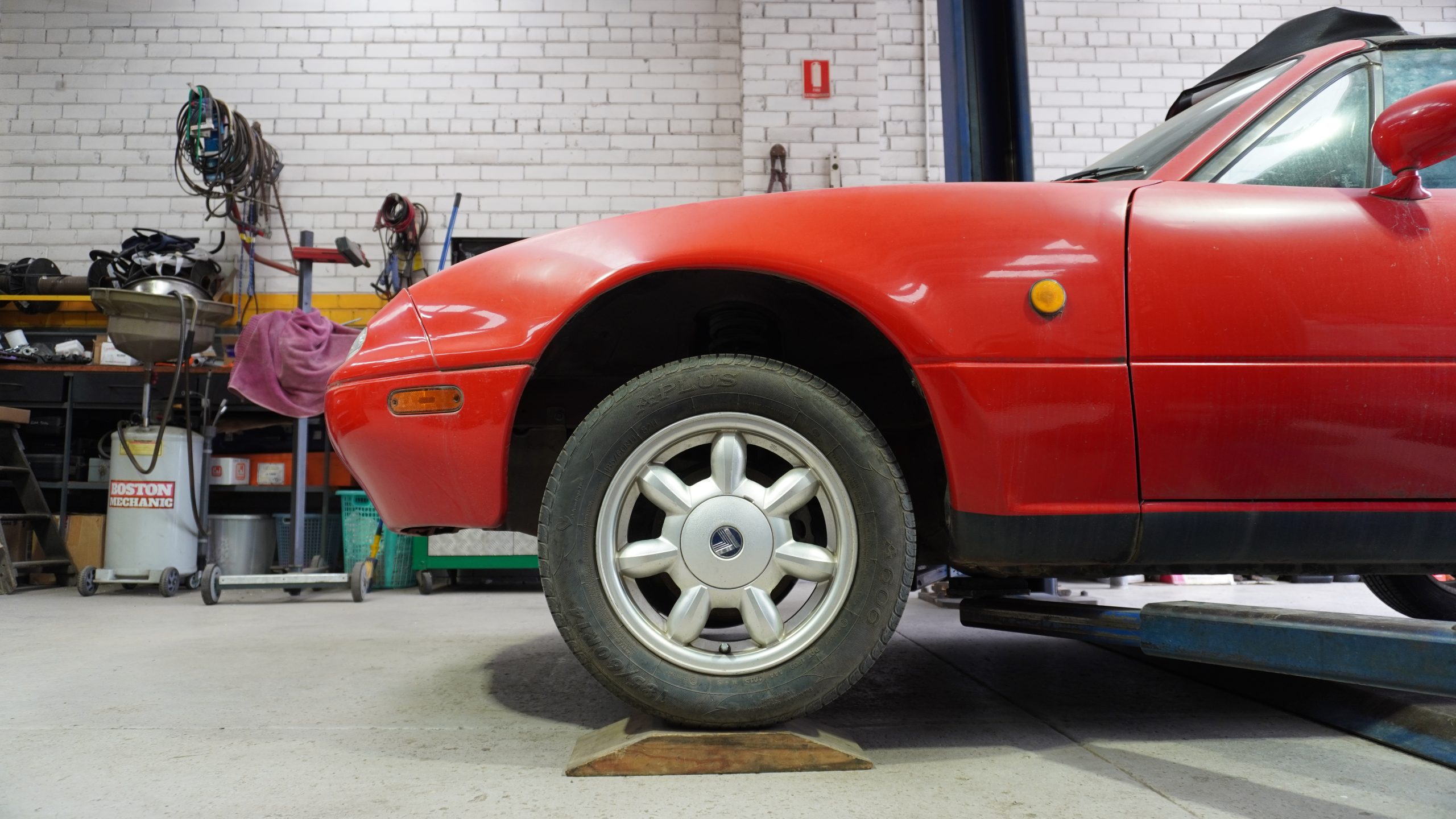
Scenario 2: The Sprung Assembly Moves
This is less desireable. if the unsprung components are too heavy, they can’t accelerate/react quickly enough to road surface changes. The tyre momentarily loses contact with the road, which reduces grip and stability. In some cases, the heavier assembly can also carry the body (sprung mass) with it. This creates a rough ride and can introduce more pronounced bump steer intereference, making the vehicle less predictable in hard cornering and braking scenarios.
The lesson here is simple: ligher, unsprung assemblies allow the suspension to respond with less resistance, therefore improving its characteristics overall.
Rotational Inertia and Gyroscopic Effects
When mass spins, it resists changes to its orientation – this resistance is called rotational inertia. Gyroscopic stability is a consequence of that inertia: the faster or heavier a rotating object is, the more it resists being turned away from its axis.
A useful way to visualise this is with a spinning top – once it’s rotating, it stays upright and resists tipping becuase of its angular momentum. The same principle applies to your brake rotors and wheels: the heavier they are, the more it resists changes in direction.
This manifests as steering resistance or non-linear turn-in response. It also demands more torque for acceleration/deceleration – all these effects are modest but can be noticable depending on your setup.

Rotating Mass Distribution / Polar Moment of Inertia
This is arguably an often, overlooked aspect of performance design. It’s not how much a rotating component weighs, but where that weight is. For any rotating component, the moment of inertia is calculated as:
Each portion of mass contributes in proportion to the square of its distance from the centre. That means 100g saved at the outer circumference of the rotor is far more effective than 100g near the hub.
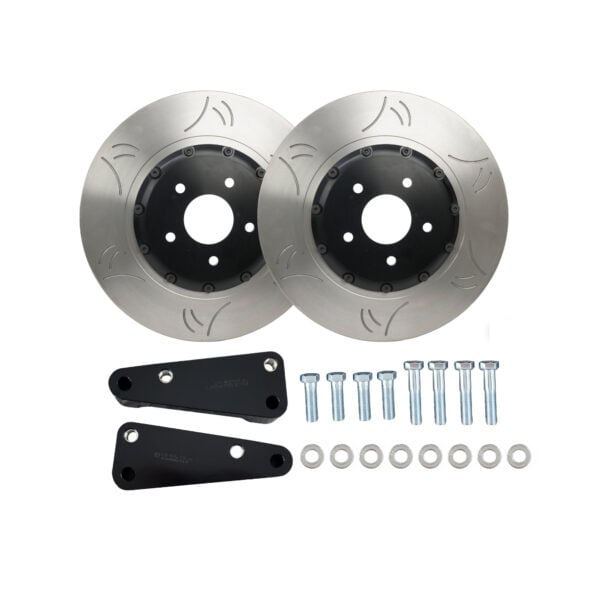
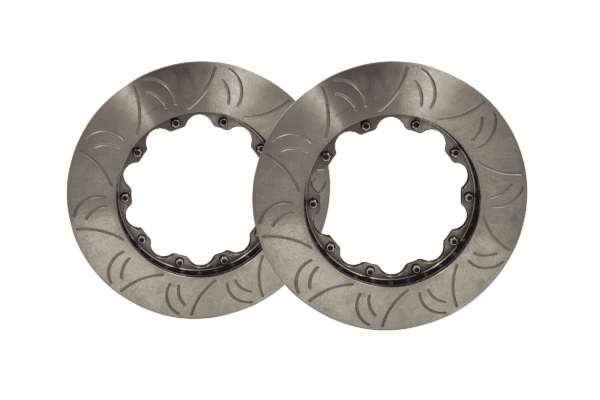
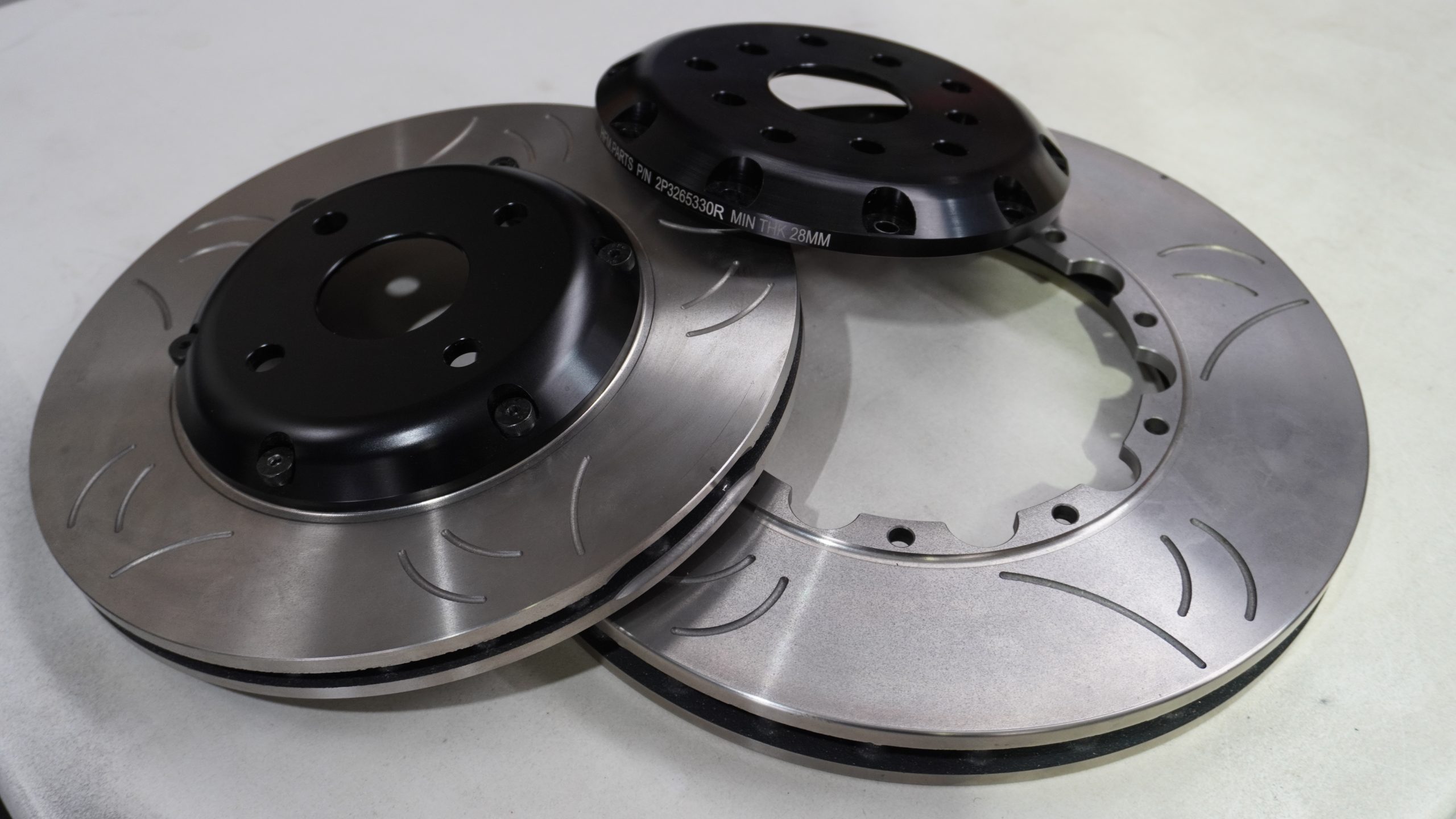
In the case of two-piece rotors, most of the weight saving somes from replacing the inner iron hat with an aluminum one. This does reduce the overall mass, but since the saved weight is concentrated near the centre, the impact on rotational inertia is relatively small. The outer ring – the part doing the actual braking – remains heavy for good reason as it needs the thermal mass to absorb heat while the increased surface area and vein pattern helps to dissipate the heat efficienctly.
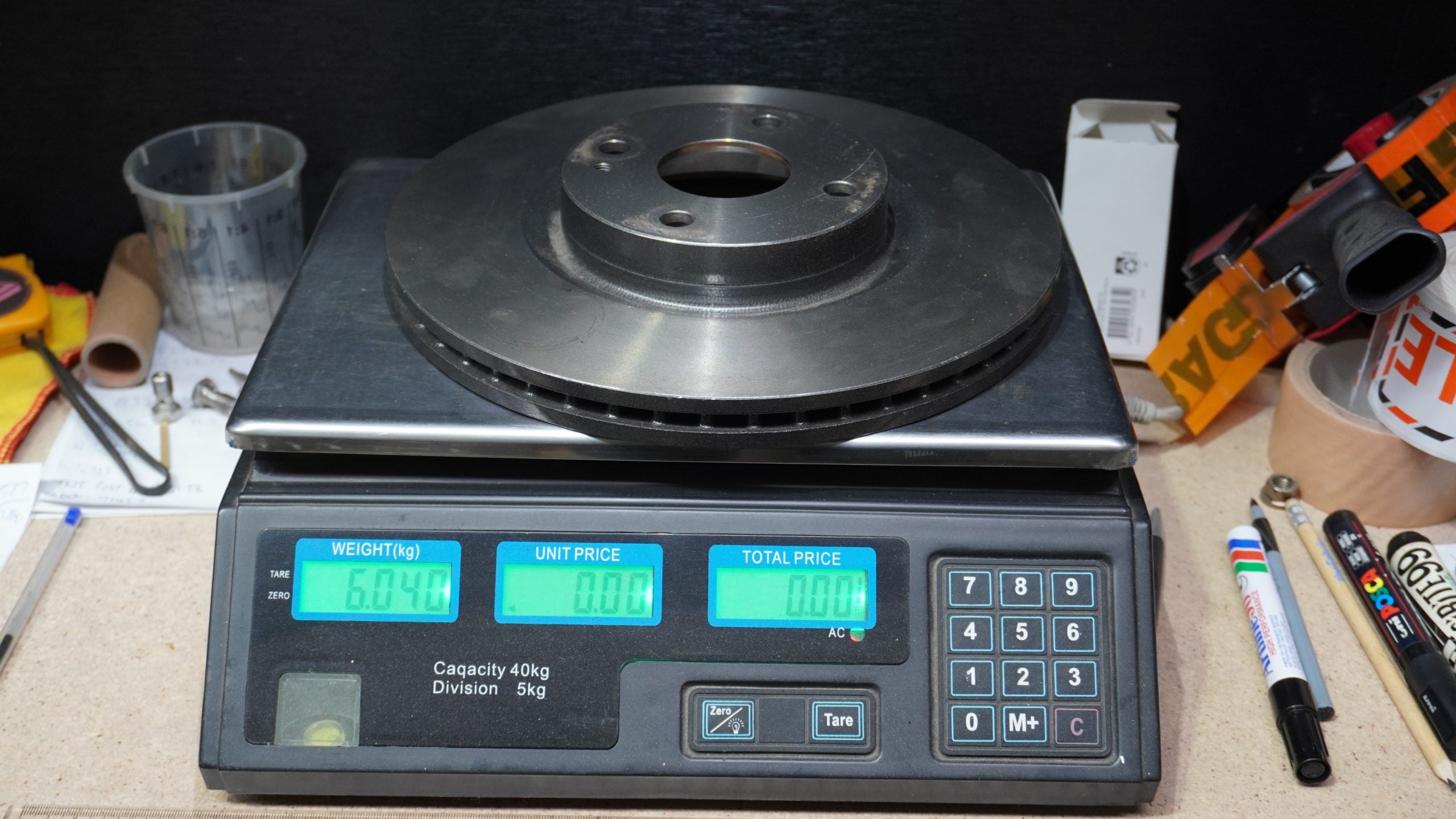
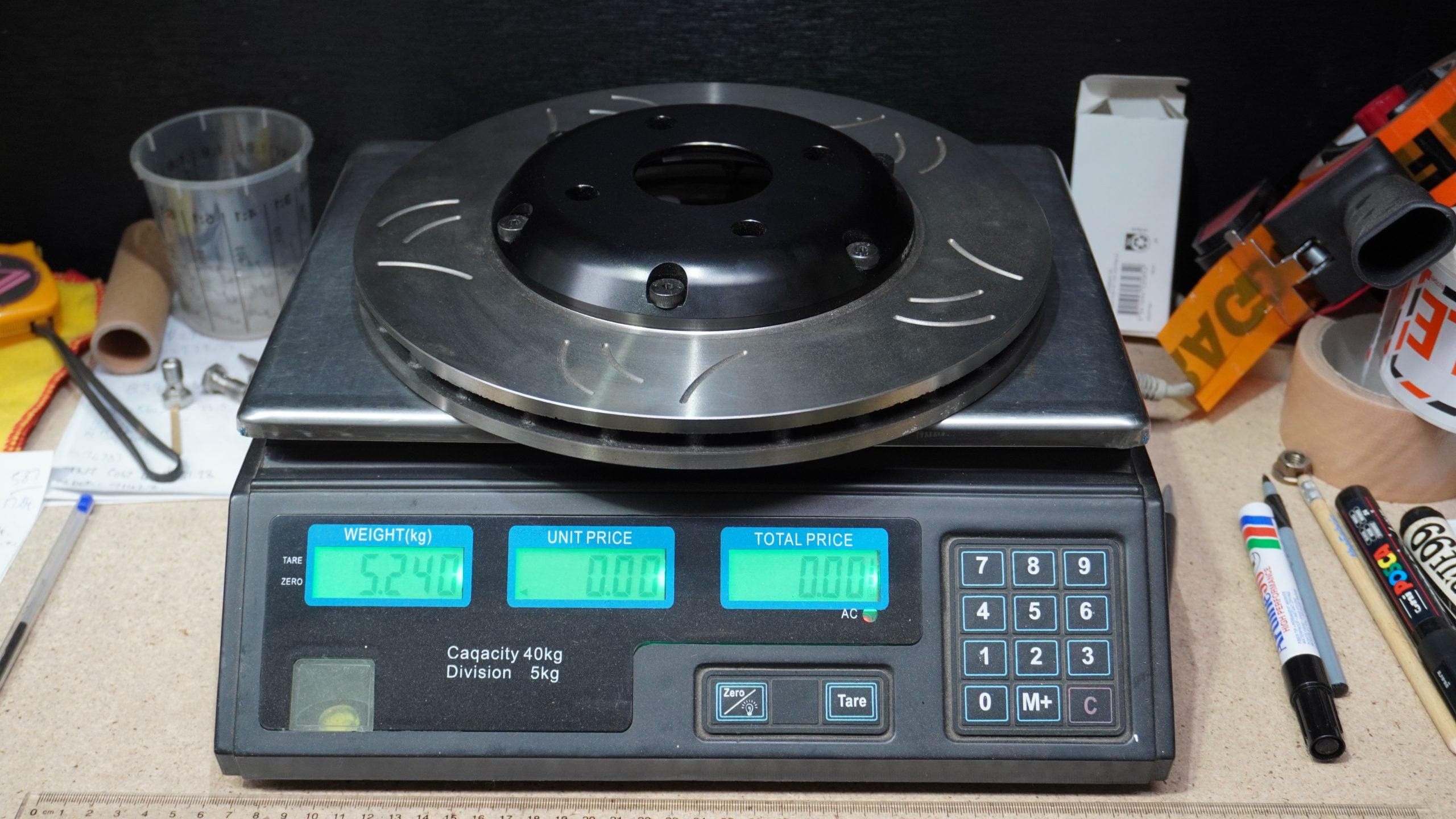
Put another way, there are diminishing returns from making the hat excessively large or thin, especially if it compromises stiffness or thermal capacity.
So Why Two-Piece Rotors?
Given that weight is saved mostly near the centre, why bother with the extra cost and complexity? Two-piece rotors provide other advantages that become increasingly important with higher braking demands.
Cooling Efficiency
This is where two-piece rotors excel. In reducing the overall mass whilst retaining or increasing the rotor diameter, the surface area : volume ratio increases. This increase in surface area enables a quicker dissipation of heat in between braking events. In practice, this improves rotor life, especially in endurance racing as the rotor temperatures are managed more efficiently. Couple that with an increased centre-area and defined vein pattern, the pumping capacity for the air throughout the rotor is increased, further increasing its cooling characteristics.
Thermal Isolation
Although aluminium conducts heat more efficiently than grey cast iron, the geometry and intereface between the two materials are what create the isolation effect. The majority of braking is concentrated at the friction surface – often exceeding 500°C at the outer ring – but this energy rapidly dissipates through convetion in the rotor vanes and radiation from the outer faces. By the time the inner mounting face of the iron ring is reached, temperatures will drop back down to 150-200°C. The joint between the iron ring and the aluminium hat is not a continuous bond but a bolted mechanical intereface with limited contact area, small air gaps, oxide films and heat-treated anodized surfaces. These discontinuities introduce thermal contact resistance, which throttle the flow of heat despite aluminium’s higher intrinsic conductivity. The result is a hat that warms gradually rather than instantly, spreading whatever heat it does absorb over a large surface area that cools quickly by exposure to ambient air. The outcome is slower and smaller temperature rise at the hub, protecting the wheel bearings, studs, and grease from heat soak without the need for floating hardware. In practice, two-piece rotors routinely show hub-side temperatures 30-50% lower than comparable one-piece designs, not because aluminium blocks heat , but because the mechanical and geometric path of conduction is intentionally disrupted.

In short, the system manages heat more intelligently.
Serviceability
The two-piece design also brings practical benefits. Because the aluminium hat and the cast iron ring are bolted together, rather than cast as one, the hat can be retained when the friction ring needs replacing. Replacement friction rings come at a reduced cost, and helps to reduce waste. The aluminium hat is both heat treated and anodized to ensure longevity.

Summary:
Two-piece rotors don’t reduce braking distances (or at least, not significantly). They’re made popular because of their ability to maintain temperature, consistency and longevity. The reduction in mass does have benefits, just in different ways to most people understand them to be. Hopefully this blog succeeds in dispelling some of those myths.