
If you track your car, running brake ducts often makes more sense than not – but done wrong, they can cause more harm than good. This post breaks down what brake ducts are really doing, the common pitfalls, and why we at HFM.Parts have decided to enter this market.
What Are Brake Ducts Really Doing?
To recap: brakes turn kinetic energy into heat – the harder you brake and the more frequently you do so, the more heat is produced. The hotter your brakes get, the more consumables you’ll burn through, thus, the more money you’ll spend to maintain your system and so on.
Well-designed brake ducts combat this by feeding cool air into the system, lowering peak and average temperatures. The research I’ve found suggests that you can expect double the working life from your consumables (fluids, pads and rotors), when cooling is managed effectively.
You’re probably wondering what I mean by “well-designed brake ducts”? To best explain myself, this post will also talk you through some fluid dynamics fundamentals and some little jerry-rigged simulations that’ll give you a better picture of what’s going on.
Why We’re Entering This Market
- The existing market for similar components has several critical flaws that this product addresses. This requires a bit of explanation, so we’ll return to this point in the summary.
- This product helps to realise the performance potential of your existing brake setup, as well as increase its working lifespan. Our research predicts a doubled working life, which will save you on pad and rotor replacements.
Addressing Critical Problem Areas
Duct-to-Rotor Outlet
Starting off with the most critical issue, directing air onto the rotor can lead to rotor cracking. This happens because the chemical bonds inside the rotor expand as the rotor heats up. When cool air is vented either mostly or partially onto only one rotor face, that causes only one side of the rotor to contract. This creates stress points across the rotor centre of the rotor faces, which can/often result in the rotor cracking completely due to this induced stress area.
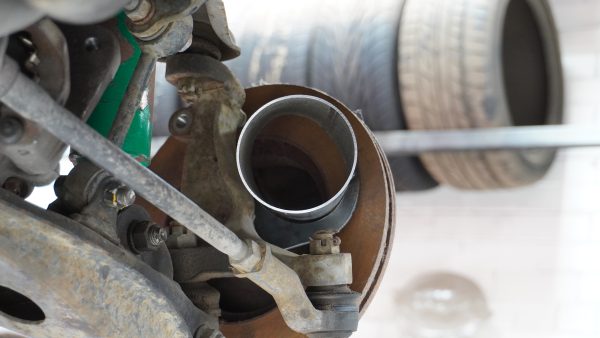
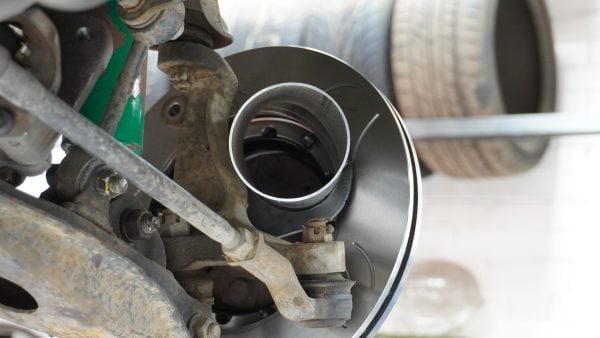
This is why it’s so important to vent only to the inlet veins that you’ll find underneath the centre hat of a rotor. The veins are set up such that when spinning, the rotor sort of becomes a centrifugal pump – pulling air from the centre, pulling it through the veins and spitting it out into the wheel well. By feeding cool air through the veins, you allow the rotor to distribute the cool air evenly across both faces, ensuring that there are no stress contractions that arise when rapidly cooling the rotor between braking zones.
Foregoing Dust Shields
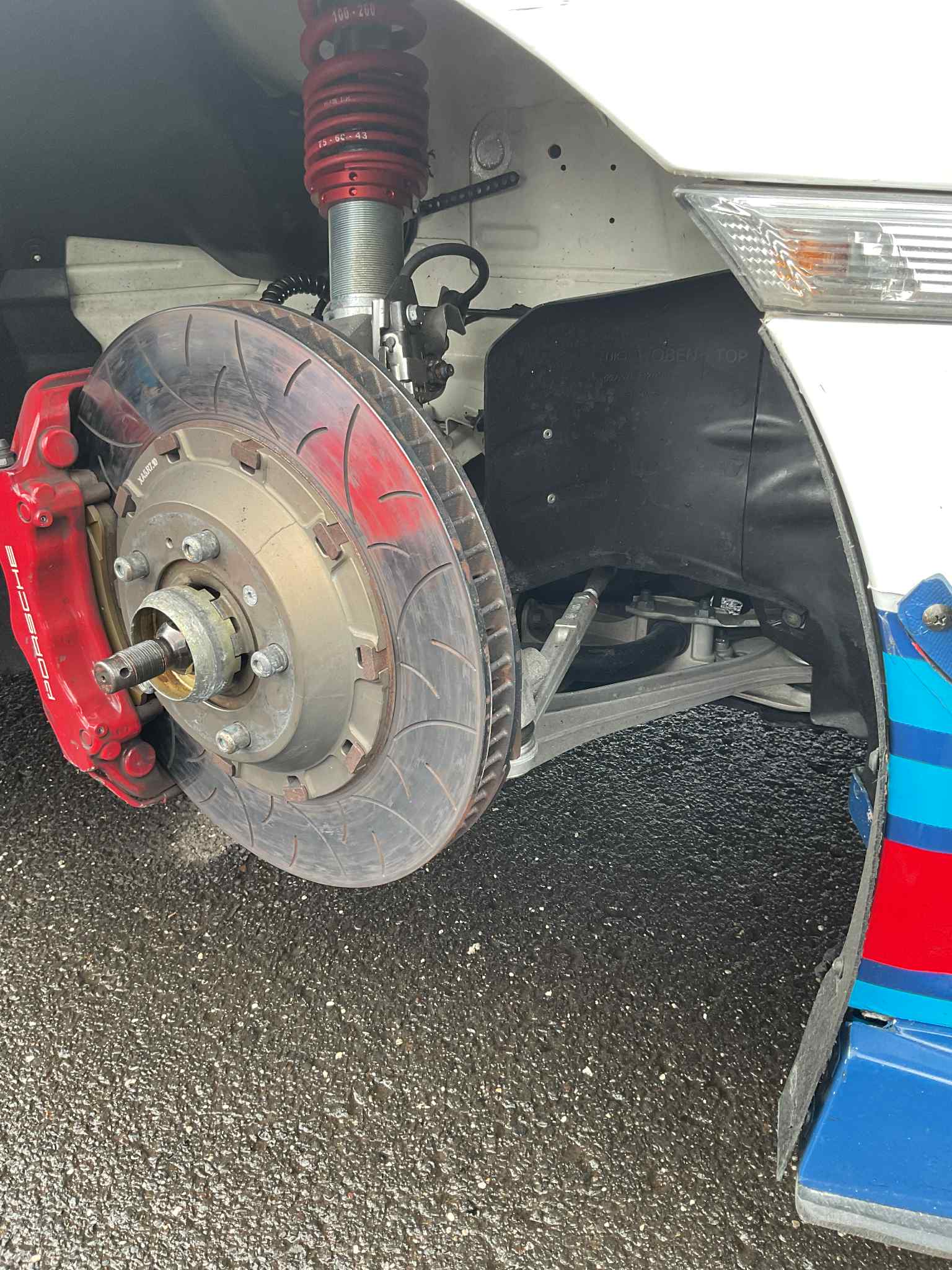
Leading on from this point, we frequently see increased rotor and pad wear on the inside rotor face, but only on cars with dust shields still installed. These dust plates act as a heat barrier and reflector – rather than allowing heat to escape into the wheel well, the duct mounting plate traps and reflects the heat radiating from the inner disc. This is why our product only vents straight into the rotor veins, with minimal area elsewhere that could negatively affect the convection of heat coming off the inner rotor face. Still not convinced? Take a look at the high-end products offered by AP-Racing or these Porsche Cup Car setups – no dust shields there either.

Why 3″ Diameter? (A Quick Lesson on Fluid Dynamics)
To understand the necessity for a 3″ duct diameter, we first need to understand friction induced flow restriction in ducts pipes. Friction in ducts is caused by this theory called the no-slip condition. This states that when fluid is next to a wall (boundary), the fluid immediately (e.g., 0mm) adjacent to the boundary has zero relative velocity. As the fluid gets further away from the boundary (e.g, 0.001mm) the flow increases, and it creates this sort of a velocity profile through the pipe, like this:

As you can see here, the no-slip condition occurs at the walls of the duct, and the airflow velocity increases further away from the pipe walls. The transition from zero air velocity at the walls of the pipe to fully developed flow in the centre of the boundary layer.
The surface roughness of a material plays a critical role in dictating how significant the boundary layer affects flow. A high surface roughness introduces lots of disturbances into the flow, amplifying the turbulence and increasing the negative effects of the boundary layer. This means that the smoother the inner material of a duct, the better flow performance you will achieve.
This is where the 3” sizing comes into effect. The boundary layer in a circular pipe results in a reduced diameter where the air is actually moving freely at the specified flow rate. A general rule for laminar scenarios is that ducts with double the diameter (e.g, 1.5” vs. 3”) will result in 16 times more flow.
So essentially, the fluid moving at the specified flow rate would theoretically only occur in the middle of the duct, where the fluid is far enough away from the boundary layers as not to be affected by the resistance due to friction. For a sufficient flow of air, you want a pipe that has a smoother inner material surface and the largest diameter duct feasible.
Applied Theory:
Rather than doing lots of math and physics equations, I figured a more accurate and engaging approach would be to run several simulations of the flow on our Mx-5 Brake Ducts (MXBD) setup. I say “accurate” in quotation marks because it’s very difficult to replicate a real-life scenario, with elements such as wind speed and direction, etc., onto a simulation software, which is rarely representative of performance in more realistic conditions. However, this study still demonstrates how the two ducts behave relative to each other, given the same boundary conditions.
For this study, the airflow inlet speeds were set to just 28m/s (~100kph) where air pressure and velocity were analysed. It uses a rough sketch of the MXBD shape and dimensions – this will be accurate enough to demonstrate the delta between the two ducts.
2″
3″
This comparison shows that the flow velocity of air through the 3″ duct is about 7.8 times faster than of that of the 2″ duct for our MXBD design. Also note how the air in the centre of the pipe travels faster than the air closer to the pipe walls – reinforcing the no-slip condition and boundary layer theories we discussed earlier.
Analysing The Theory and Simulations
So what does this all tell us? The theory and simulations conducted here help to reinforce the decisions I’ve made when designing this product, demonstrating why diameter, direction and pickup points were all critical to ensuring that these products deliver on their promise. Let’s go over these points:
- The brake duct directs air through to the rotor centre hat
- Ensures the rotor is cooled evenly between faces
- Reduces rotor tendencies to cracking due to uneven temperature/stress concentration areas
- Brake duct diameter
- Overcomes the no-slip condition
- Reduces the effects created by boundary conditions
What this post is missing is real-world studies to back up all the theory and simulation claims that I’ve raised in this post. Several experimental tests will be conducted at an upcoming trackday, where we’ll be testing these components on track with several variations to the setup that best illustrate the real-world performance – stay tuned for more.
